Training Considerations for ACL: Why Your Program Needs More Than Quads and Hamstrings
Most ACL training programs lean hard on two muscle groups: the quads and the hamstrings. They matter. But if that’s all you train, you’re leaving some of the knee’s best protection on the table.
In this blog post, we will touch on some functional anatomy behind ACL injuries. We will also touch on a research study that supports how we approach ACL rehab, prehab and return to play.
How the ACL gets overloaded
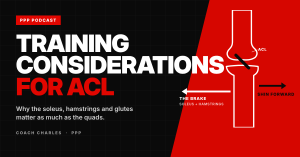
The anterior cruciate ligament (ACL) runs from the femur to the tibia. One of its main jobs is to stop the shin bone from sliding too far forward.
When an athlete decelerates, the tibia drives forward. Add a twisting motion at the same moment and the ACL takes on more load than it can handle. That combination of forward shin travel plus rotation is the classic setup for a non-contact ACL injury.
So the real question in ACL training is simple: what else can control how far the shin moves forward and how much it rotates?
Start below the knee: ankle laxity and lower-limb stiffness
Athletes with too much laxity around the ankle often let the tibia travel too far forward. You can spot this with passive and active range-of-motion testing.
On a force plate, measuring active stiffness often shows the lower limb lacks adequate stiffness. The muscles around the ankle and knee need two qualities:
- Capacity: enough strength to resist the load.
- Reactivity: the ability to contract fast enough to matter during landing and cutting.
When both are in place, you build a protective mechanism for the ACL. You also build a performance mechanism: a more effective stretch-shortening cycle and stronger co-contraction, which means quicker ground contacts.
What the research says: Maniar et al. (2020)
A 2020 study by Maniar et al, in the Scandinavian Journal of Medicine & Science in Sports modeled how individual lower-limb muscles affect knee loading during a single-leg drop landing from a 0.31 m box.
The researchers looked at muscles that cross the knee and muscles that don’t. They measured each one’s contribution to tibiofemoral shear force plus valgus and rotational moments. Key findings:
- The soleus, medial hamstrings and biceps femoris were the main sources of posterior shear force, the force that pulls the tibia back and offloads the ACL. Contributions reached about 393 N, 359 N and 162 N.
- The gluteus medius, gluteus minimus and soleus were the main muscles resisting the valgus (knee-caving) moment.
In plain terms, the soleus and hamstrings act like a brake on the shin. The lateral hip helps keep the knee from collapsing inward.
How we train for ACL robustness at PPP
Based on this functional anatomy and research, our ACL training emphasizes:
- Soleus strength and reactivity: we load the soleus directly will also adding direct exercise to improve reactivity
- Medial and lateral hamstrings: we alter variations to ensure we develop the hamstring holistically
- Lateral hip musculature: glute med, glute min and the whole lateral hip system.
The quads are essential for developing the ACL, but the lower limb is a system that must be approached as such.
ACL rehab and return to play at PPP
When you do ACL rehab with PPP, we evaluate the entire system, find the areas that should be protecting you, and develop them holistically. ACL return to play, especially in the strength and performance phase, is good, hard, holistic training.
Listen to the full episode for Coach Charles’s complete breakdown, and contact PPP to schedule an ACL evaluation.
This article is for education only and isn’t a substitute for an individual evaluation by a qualified clinician.
Hashtags: #ACLTraining #ACLRehab #ACLRecovery #ACLInjury #ACLPrevention #KneeRehab #ReturnToPlay #SportsPerformance #StrengthAndConditioning #InjuryPrevention #AthleteDevelopment #PhysicalTherapy #SoleusStrength #HamstringStrength #CoachCharles #PPP
Last Updated by Charles Sams
10/6/2026